

3Tentos, Calm Ship in Troubled Waters
- Grupo de Negócios da Escola Politécnica da USP
- 9 de dez. de 2025
- 4 min de leitura

How, in a market with increasingly tight margins, can companies like 3Tentos succeed and outperform national and international giants?
Bruno Ferro (Junior Member)
Although Brazil is considered an agribusiness-centered country, the sector is far from calm or easy to operate in. In the first quarter of 2025, approximately 81 companies filed for bankruptcy protection, primarily due to their inability to service debts taken on during a period of high interest rates, maturing amid the devaluation of key export commodities and a decline in domestic consumption. Companies that act as intermediaries in the agribusiness cycle are also constantly affected, positively or negatively, by the sector's economic cycles. To mitigate these risks, major players in the intermediation segment seek to broaden their range of businesses, minimizing risks and increasing market reach.
Agribusiness in Brazil is a hallmark of the country abroad, combining technological development with the quality of its final products. Major economic blocs, such as the European Union, impose restrictions on Brazilian imports due to the high efficiency and lower costs practiced by domestic producers. France, for example, the leading agricultural producer in Europe, has consistently voted against trade agreements involving Brazilian agribusiness. In addition to being a driver of domestic output, Brazil's trade balance also depends on the large volume of transactions in the sector to maintain and achieve primary surplus targets.
Brazil's GDP by Sector (R$ Trillions):

The intermediation segment connects producers, suppliers, and consumers. Agricultural retail is the primary example: the supply of inputs for planting marks the beginning of a production's risk, particularly in the face of external events that can damage a harvest and make it unfeasible for the farmer to repay the credit taken on, driving up interest rates and squeezing margins both in the field and in the market at the point of sale to the end consumer. To increase competitiveness, companies such as Agrogalaxy, Nutrien, and 3Tentos itself seek to diversify their operations, offering not only input resale, but also functioning as a complete marketplace for the field and its production.
Simplified Diagram of Company Operations in the Sector:

3Tentos's business model stands out from its competitors, primarily through its diversification of services. The first differentiator lies in the financing of agricultural inputs via barter, a form of credit in which, instead of using traditional credit lines, payment is made with a portion of the harvest's production. This model reduces the risk of default, as debt collection in Brazil is difficult. Furthermore, once a producer's credit is blocked due to default, they are unable to acquire new inputs to pay off the previous debt, generating a "snowball" effect that leads to low productivity among small and medium-sized producers. By adopting this alternative form of financing, 3Tentos not only provides a service, but also becomes a partner to the farmer, sharing the same objective: the maximization of productivity.
The second differentiator lies in the trading and logistics of grains obtained via barter. With significant storage capacity, 3Tentos can wait for more favorable market prices, selling during peaks and stockpiling during periods of lower profitability. The scale of operations is essential in giving medium-sized producers access to large national and international markets, since, individually, their bargaining power would be limited by their low scale. The incentive for producers to become 3Tentos partners applies both at the initial stage of production and at the point of sale, with fair margins assured and specialized consultant support throughout the entire planting cycle.
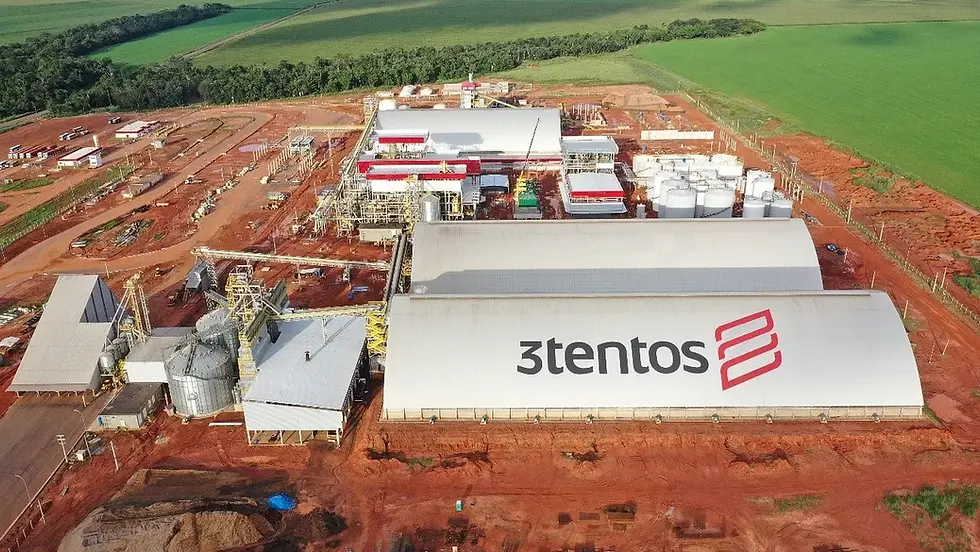
The third operational arm is the industrial one, the link that closes the company's ecosystem. Soybeans sourced from the field are processed and transformed into oil, meal, and biodiesel, broadening value capture per ton and increasing resilience to market cycles. The company operates industrial units in RS (Ijuí and Cruz Alta) and MT (Vera), with recent upgrades for energy efficiency, including the use of biomass and byproducts, and greater integration with origination. The industrial plant model allows engineering teams to rapidly adjust the mix between oil, meal, and biodiesel according to spreads and demand, focusing on the most profitable output at any given moment. This integration also supports traceability and low-carbon programs (RenovaBio/CBIOs), reinforcing competitive licensing in markets that require environmental certification, a significant comparative advantage, particularly in light of European requirements.
3Tentos's success comes at the same time its main competitors face turbulence. Agrogalaxy, the leading marketplace in Brazilian agribusiness, achieved that title through inorganic growth, that is, mergers and acquisitions of regional operations brought together under a single commercial brand. The strategy was successful in increasing market share, but the high costs of the acquisitions, combined with the sector's long-term payment characteristics, took their toll. Approximately one year after the end of the acquisition cycle, Agrogalaxy filed for bankruptcy protection to renegotiate its debts. Unlike Agrogalaxy, 3Tentos adopts a more gradual growth strategy, based on its greatest asset: its relationship with producers. The business model is not only rooted in financing or cultivation, but also embedded in farming culture. The comparison with Agrogalaxy shows that it is not always the largest ship that best weathers the storm, but rather the one with the best crew.