

Malaysia: The New Player in Semiconductor Geopolitics

With billion-dollar investments, tax incentives and a bet on training engineers, the country has been attracting industry giants and promises to become a key piece in the global reconfiguration of the industry.
Gustavo Rabinovitz (Senior at GN Poli)
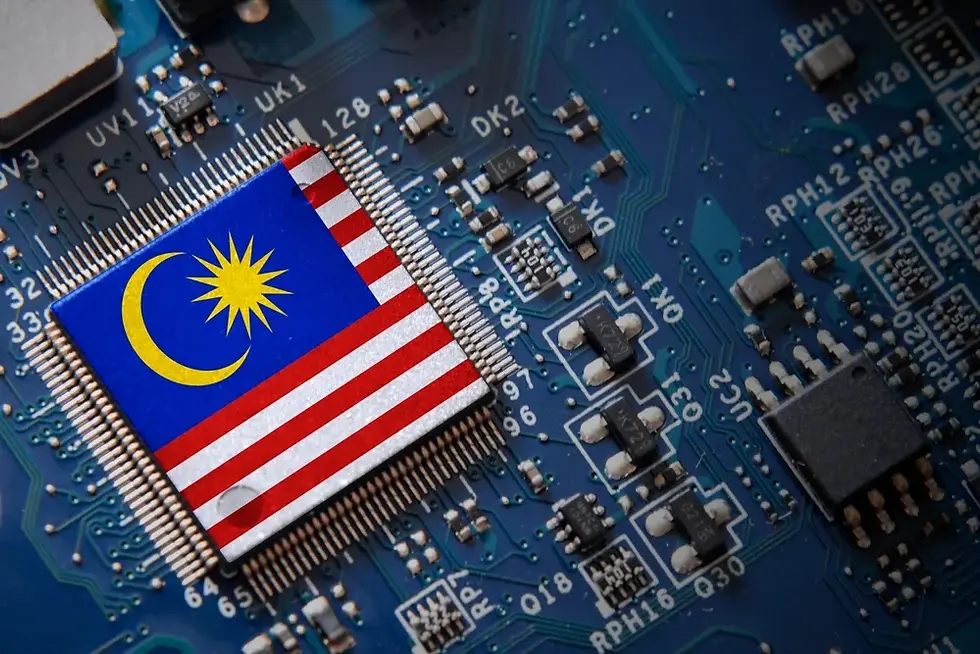
While the world turns its attention to the headlines of the trade war between the United States and China, a quiet movement, but one with great transformative potential, is taking place on the Asian continent and promises to redefine the global map of the semiconductor industry. And it is not Taiwan we are talking about, but Malaysia.
The relevance of semiconductors in today's world is becoming increasingly clear. Considered the “oil of the twenty-first century”, these small electronic components are the invisible brains behind everything from the simplest technological device, such as a toaster, to the protagonists of the contemporary technological revolution, such as AI, 5G, cars (especially electric ones) and the most advanced weapons held by armed forces. The product, in its many variations, generated US$627 billion in sales in 2024, with expectations of reaching US$1 trillion by 2030. Today, semiconductors are the backbone of the economy, and the world's dependence on them gives those who produce them significant geopolitical power.
It is no wonder that, in recent years, tensions between China and Taiwan have drawn so much attention: beyond the military aspect, China's intention to reunify the island with its national territory carries a strong economic dimension. This is because Taiwan, particularly through TSMC, accounts for about 60% of the world's capacity to manufacture leading-edge chips and almost 90% of the most advanced process chips (below 7 nanometers). This has caused serious concern among major countries, companies and investors, who have made the geographic diversification of production one of the sector's top priorities.
Today, the semiconductor market is divided across several fronts. Despite Taiwan's dominance in the production volume of the most sophisticated chips and Japan having the largest number of fabrication plants, the United States leads in chip design, with about 46% of the global market share. After Taiwan, South Korea, with Samsung, accounts for 10% of global production of leading-edge chips (used in the most advanced technologies). China is the largest consumer market, absorbing more than 30% of the chips produced worldwide, while Japan and Europe hold important shares in the production of chips for the automotive market. The fact is that, in this distribution, each country depends on the others, whether for design, technology or expertise. But, at the end of the day, the one who dominates the game is Taiwan.
Number of semiconductor fabrication plants in 2024 (Source: World Population Review)

This is where Malaysia comes in, a country of about 35 million people located in the heart of Southeast Asia and crossed by major global shipping routes. Already traditionally strong in the testing, assembly and packaging stage, accounting for approximately 13% of global volume, the country is now betting on expansion to move up the value chain.
To that end, the Malaysian government developed the National Semiconductor Strategy, mobilizing around RM500 billion (US$107 billion) in projected investments through 2030. The goal is to double the country's share of the global semiconductor chain, increasing its presence in the design, wafer fabrication and new materials research segments. By 2030, the plan also calls for training 60,000 new engineers, which is necessary considering that the country currently trains about 6,000 specialized professionals per year.
Since 2016, the growth of Malaysia's electronics exports has been remarkable, both in volume and in global share. This has gone hand in hand with investment in these industries, which has accounted for more than 80% of foreign investment in the country since 2021.
Malaysian electronics exports (Source: Harvard Growth Lab)

Tech giants are part of these bets. Intel announced investments of US$7 billion to expand its packaging and assembly capacity in the Penang and Kulim regions. Infineon Technologies is investing US$5 billion to build the world's largest 200mm wafer fab (silicon structures used in computers) in Malaysia. Other companies, such as Nvidia, the giant featured in last week's newsletter, have also been exploring the country as part of their diversification. Malaysia's neutrality regarding the tensions between China and the United States works in its favor as a destination for a wide variety of companies.
The Malaysian government has also implemented tax incentives, such as Pioneer Status (a tax exemption of up to 10 years), to attract high-value players. The New Industrial Master Plan 2030 (NIMP 2030) includes targets to increase Malaysia's share of front-end activities, such as chip design, which today represents less than 10% of local activity. In this regard, in March 2025, the Malaysian government signed an agreement with the British company Arm Holdings worth US$250 million. The package includes access to Arm's intellectual property, in addition to the opening of the company's first office in Southeast Asia, in Kuala Lumpur. This symbolizes one of the steps the country has taken in its mission to move up the production chain and marks Malaysia's leadership relative to its neighbors.
In the words of Anwar Ibrahim, Malaysia's prime minister: “(the agreement) marks a fundamental shift in our approach to semiconductors and technology, which will define our future. One of the most ambitious technology plans Malaysia has ever seen”.
Not even Brazil has escaped Malaysia's advance: in April, during an international InvestRS mission, Rio Grande do Sul began talks with the Malaysian semiconductor manufacturer Silterra, which expressed interest in building a semiconductor plant in the state.
While Taiwan, the United States, China and even South Korea remain at the center of attention, Malaysia is gaining ground with a solid strategy, large investments and, most importantly, the support of the major players in today's most important sector for technology, the economy and geopolitics. Progress is still at an early stage. But with each step, the country moves closer to its goals of climbing the production chain and gains more relevance. And since in the business world we must always keep an eye on future opportunities, Malaysia increasingly presents itself as a country that cannot, under any circumstances, be ignored.


