

Palantir: Between Innovation and Surveillance

How Peter Thiel's company became essential to governments and corporations, and why its power is redefining the future of warfare, business and surveillance.
Francisco Behr (Junior at GN Poli)

In the competitive world of technology, few companies are as enigmatic and influential as Palantir. While the world discusses artificial intelligence through chatbots and image generators, Palantir applies the technology in life-or-death scenarios, having recently become a key piece of Ukraine's digital arsenal against the Russian occupation. By analyzing satellite data and intelligence to identify targets and predict troop movements, the company not only reaffirms its role as the brain behind critical operations, but also lays bare a new reality: the wars of the future, and the big business surrounding them, will be defined by whoever has the best algorithm. Understanding Palantir is therefore essential to understanding how AI is reshaping not only business, but the very structures of power in the twenty-first century.
At the heart of this mystique lies an origin that blends the trauma of 9/11 with Silicon Valley audacity. Founded in 2003, Palantir was born with a clear mission: to develop for U.S. intelligence agencies the kind of technology PayPal used to detect fraud, but applied to hunting terrorists. The driving force behind the company reflects a fascinating contrast: on one side, Peter Thiel, the billionaire co-founder of PayPal, visionary investor and prominent figure of libertarian philosophy; on the other, Alex Karp, the eccentric CEO with a PhD in German neoclassical philosophy, who still leads the company today with a discourse that sounds more like a sociology lecture than an earnings presentation. This unlikely duo, the ideological investor and the philosopher-manager, was fundamental in creating a unique corporate culture, balanced between the defense of Western values and the relentless pursuit of government and corporate contracts.
But what exactly does Palantir sell? The answer lies in its ability to solve one of the biggest problems of large organizations: data fragmentation. The company does not offer an off-the-shelf solution, but rather an operating system for data, with two main fronts: the Gotham platform, developed for the defense and intelligence sector, and Foundry, aimed at corporate clients. Both work on the same principle: integrating disparate data sources, spreadsheets, field reports, satellite images and financial records into a single interface where analysts can visualize hidden connections. In the defense sector, this means optimizing the logistics of tanks and ammunition in real time. In finance, it allows banks such as Credit Suisse to fight money laundering. In healthcare, during the Covid-19 pandemic, governments used Foundry to manage vaccine distribution and forecast hospital bed occupancy. In practice, the company positions itself as a provider of critical, invisible infrastructure for governments and corporations.
This power, however, inevitably generates controversy. If Palantir's technology is capable of finding needles in data haystacks, it can also turn those haystacks into a mass surveillance network. The harshest criticism arose from its contracts with the U.S. immigration agency, in which its platform was used to cross-reference data and facilitate deportations. For privacy advocates, Palantir symbolizes the risk of a centralized and opaque “surveillance state”. The dilemma is not exclusive to the company; it echoes the controversies surrounding Meta in the Cambridge Analytica scandal and Google in debates over the use of user data. The difference is that, while other big techs collect data from the public to sell advertising, Palantir organizes its clients' sensitive data to enable high-impact decisions, making the debate on ethics and governance even more complex and urgent.
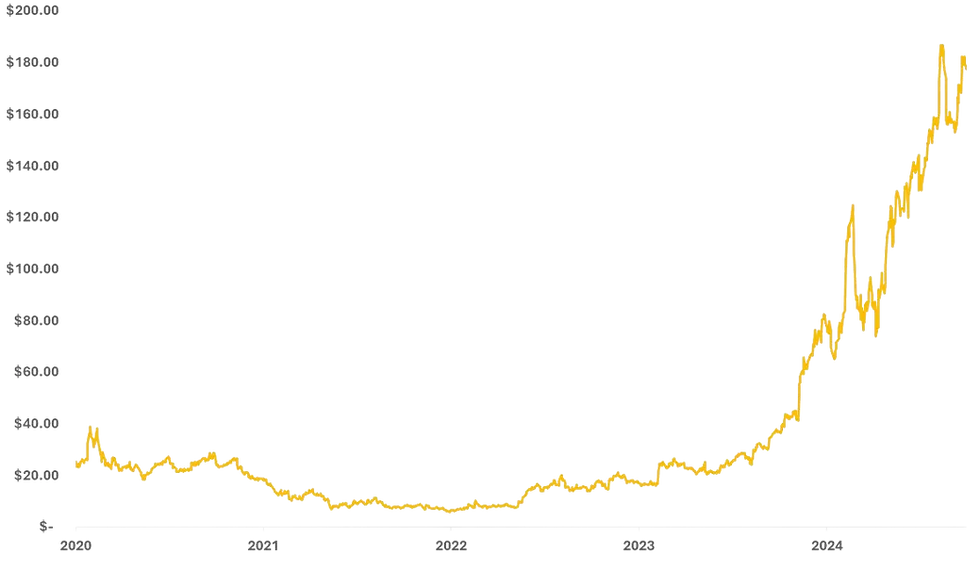
This duality is directly reflected on Wall Street. Palantir went public in September 2020 through a direct listing and, since then, its shares have been marked by strong volatility. The company divides analysts and investors. On one side, optimists see it as an irreplaceable piece in the modernization of Western defense and the digital transformation of industries, with long-term contracts that guarantee resilient revenue. For them, Palantir has the potential to be the next great software company, justifying its high multiples (around 590 times price-to-earnings). On the other side, skeptics point to its heavy dependence on government contracts, its long and costly sales cycle and a profitability whose consistency is still uncertain. They question whether Palantir will really be able to scale its business model in the private sector to the same extent as in government, or whether the “hype” around the company is overstating its real value.
Palantir Share Price, in U.S. dollars (Nasdaq):
Looking ahead, Palantir is betting everything on generative artificial intelligence as its next growth engine. With the launch of its Artificial Intelligence Platform, the company seeks to go beyond data analysis, allowing clients such as the U.S. Army to use language models to simulate battle scenarios or pharmaceutical companies to accelerate the discovery of new drugs. The ambition is clear: to be the “Microsoft of data”, the standard operating system on which the world's most important organizations will make their decisions in the AI era. For society, Palantir's rise represents a crossroads. The promise is unprecedented efficiency in critical services, but the risk is the growing dependence of governments and companies on a single provider of sensitive technology. In the end, Palantir's trajectory is not just a business story; it is a barometer of how we will balance innovation, security and freedom in the next decade.


